Garage Door Opener Repair Phoenix: The Complete Homeowner’s Buying & Repair Guide
Imagine you're already ten minutes late for a meeting when you hit the button, but instead of the door rising, you hear a frantic clicking sound. As the temperature inside your garage climbs toward 130 degrees, you realize you're trapped. It's a high-stakes moment that many homeowners face during our brutal summers. When you're dealing with a broken system, you need a solution that's fast, reliable, and honest. That's why understanding the basics of garage door opener repair Phoenix is essential for your home's security and your own sanity.
We know that unexpected repair costs and contractors who don't show up are the last things you want to deal with. You deserve a functional, quiet garage door without the stress of hidden fees. This guide is designed to help you diagnose common opener issues, understand what goes into professional service, and decide when it's time to invest in a system built for the desert heat. We'll walk you through the latest safety regulations, compare the benefits of different drive types, and explain how to maintain your warranty so you can get back to your day with total peace of mind.
Key Takeaways
- Learn to spot the difference between mechanical failures and electronic glitches using our quick troubleshooting steps.
- Understand how Phoenix’s 110-degree heat impacts internal lubricants and why a logic board failure might be the culprit.
- Apply the "10-Year Rule" to help you decide if garage door opener repair Phoenix is a viable fix or if an upgrade is better.
- See what happens during a professional 25-point inspection, including why technicians always check your springs first.
- Find out how to secure your home quickly with 24/7 emergency services and same-day repairs available throughout the Valley.
Troubleshooting Common Garage Door Opener Issues in Phoenix
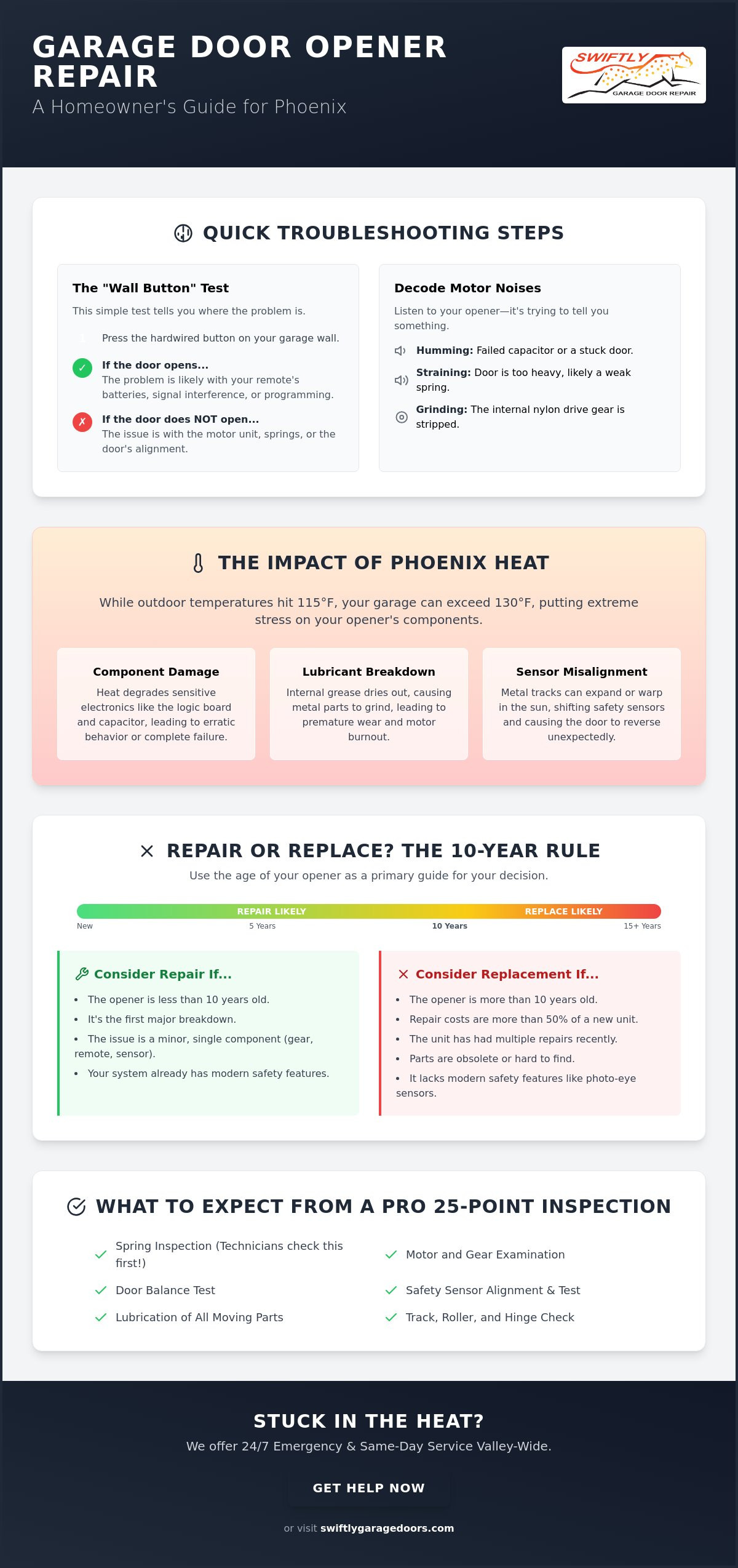
Your garage door is the largest moving part of your home. When it fails, the first step is determining whether the issue is mechanical or electronic. Mechanical problems usually involve the springs, tracks, or rollers, while electronic issues reside within the motor unit itself. Start with the "Wall Button" test. If the door opens when you push the hardwired button on the wall but refuses to budge for your remote, the motor is fine. The problem lies with your signal or the handheld unit. However, if you hear the motor working but the door stays shut, you're likely facing a broken spring or a disconnected carriage. Distinguishing these signs early is the key to a successful garage door opener repair Phoenix homeowners can trust.
Modern systems are complex. To understand the underlying mechanics, it's helpful to recognize that a standard electric garage door opener is designed to assist the springs, not do all the heavy lifting. In the Phoenix desert, extreme heat can warp tracks or cause metal to expand, putting immense strain on the motor. If your door feels heavy or jerky when operated manually, the opener isn't the problem; the door's balance is. For more information on professional diagnostics, visit Swiftly Garage Doors to see how a technician evaluates these systems.
Remote and Keypad Failures
Unresponsive remotes are a daily headache in Arizona. Before assuming the motor is dead, check for frequency interference. Local electronics, new LED light bulbs in the garage, or even nearby masonry can block the signal. Heat also drains battery life significantly faster than in cooler climates. Follow these steps to troubleshoot:
- Replace the batteries in both the remote and the exterior keypad.
- Check the antenna wire hanging from the motor unit for damage.
- Clear the opener's memory and attempt to reprogram the handheld unit.
Motor Noises and What They Mean
Listen closely to your opener; the sound it makes is a diagnostic tool. A "humming" motor that doesn't move usually indicates a failed capacitor or a door that's stuck in the tracks. A "straining" sound suggests the door is too heavy for the motor, often due to a weakening spring. The most common sound we hear during a garage door opener repair Phoenix call is a loud grinding noise. This usually means the internal nylon drive gear is stripped. These gears are designed to be the "weak link" that fails to prevent the motor from burning out. In the Valley, these plastic parts become brittle over time and require a professional swap to restore quiet, smooth operation.
The Impact of Phoenix Heat on Your Opener's Electronics
Phoenix summers aren't just hard on people; they're brutal on machinery. While outdoor temperatures hit 115°F, west-facing garages often exceed 130°F. This sustained thermal stress accelerates the breakdown of internal lubricants. When grease dries out, metal components grind against each other, leading to premature wear. If you notice your opener struggling more as the mercury rises, it's a sign that the heat is winning. Seeking a professional garage door opener repair Phoenix early can prevent a total motor burnout before the hottest months arrive.
Heat also causes physical changes in your garage door's structure. Metal tracks expand in the Arizona sun, which can shift your safety sensors just enough to break their invisible beam. This causes the door to reverse immediately after it starts closing, leaving your home unsecured. Understanding these climate-specific failures is the first step toward maintaining a reliable system.
Capacitor and Logic Board Vulnerability
Your opener's logic board is its brain, and the capacitor is the battery-like "starter" that gives the motor the kick it needs to lift a heavy door. Extreme heat is the primary enemy of these delicate parts. High temperatures can cause permanent damage to your device by degrading the sensitive circuits on the logic board. When these electronics fail, your opener may become unresponsive or behave erratically.
If your opener just "hums" without moving during a July afternoon, you likely have a blown capacitor. You can often spot a failing capacitor by looking for a bulging top or leaking fluid on the component. Monsoon season adds another layer of risk, as power surges from lightning strikes often "fry" already heat-stressed logic boards. Replacing these specific parts is a cost-effective alternative to a full motor replacement if caught early.
Safety Sensor (Photo-Eye) Sensitivity
Heat doesn't just fry electronics; it physically moves your hardware. Additionally, the intense glare of the afternoon sun can "blind" the infrared lenses of your safety sensors. If your door refuses to close only during certain times of the day, sun interference is the likely culprit. You can often fix sun glare by creating a small cardboard "sun shield" for the receiving sensor to block the direct light.
However, if the tracks have warped from thermal expansion, you'll need a professional alignment to ensure the sensors stay locked on each other. For detailed help with these delicate components, check out our resource on garage door sensor replacement Phoenix. If the heat has left you stuck in a hot garage, reaching out for a professional diagnostic is the fastest way to restore your home's security and your peace of mind.
Garage Door Opener Repair vs. Replacement: A Decision Guide
Deciding whether to fix your current system or invest in a new one is the most common dilemma homeowners face. It often comes down to a matter of math and timing. We use the "10-Year Rule" as a reliable benchmark. If your opener is over a decade old, finding replacement parts becomes difficult, and the internal components have likely suffered significant heat fatigue. Repairing a 12-year-old motor is often throwing good money after bad. In these cases, a garage door opener repair Phoenix might only buy you a few more months of service before the next component fails.
Safety is another non-negotiable factor. Federal law mandated safety sensors for all openers manufactured after January 1, 1993. If your unit lacks these photo-eyes, it's a significant safety risk and cannot be legally repaired to modern standards. Beyond safety, consider the warranty. Most repair parts carry a 90-day coverage, while a New Garage Door Opener often provides a lifetime warranty on the motor. When the cost of a new logic board and labor approaches half the price of a modern system, the long-term value of a replacement becomes clear.
When a Repair Makes Financial Sense
Repair is your best path when the issue is isolated and the unit is relatively young. If your system is under five years old, it's likely still under a manufacturer’s warranty. Minor mechanical failures like stripped nylon gears or a faulty capacitor are quick, affordable fixes that don't require a full overhaul. Sometimes, the fix is even simpler. If you find your garage door not responding to remote, it might just be a programming error or a signal interference issue that a technician can resolve in minutes. Always check these "sanity fixes" before committing to a total replacement.
When to Invest in a New Opener
Upgrading is often a strategic choice for better home management. In the Valley, power outages during summer monsoons are common. A modern opener with a battery backup ensures you aren't trapped in your garage when the grid goes down. If your current chain drive sounds like a freight train, switching to a belt-drive system provides near-silent operation and better resistance to Phoenix's extreme temperatures. Many homeowners also choose to upgrade for smart technology. Modern units allow for remote monitoring via your smartphone and secure Amazon Key delivery, giving you control over your home's security no matter where you are in the world.
What to Expect During a Professional Opener Repair Service
When a technician arrives for a garage door opener repair Phoenix homeowners should look for a methodical, safety-first approach. It starts with the door, not the motor. A professional always checks the balance and the springs before touching the opener. If a spring is broken or the door is off-track, the opener will burn out trying to lift that dead weight. A comprehensive 25-point safety inspection ensures every moving part is verified before any work begins on the electronics. This prevents you from paying for a new motor only to have it fail because of an underlying mechanical issue.
Transparency is the foundation of a good service experience. You should receive a clear breakdown of the service call fee versus the actual labor and parts required for the fix. In the Valley, we prioritize high-cycle, heat-rated replacement parts. Standard parts often fail prematurely when exposed to our 110-degree days. Using components designed for extreme thermal stress is a requirement, not an option. If you're ready for a thorough inspection, schedule your professional diagnostic today to get your system back in peak condition.
The Diagnostic Process
A thorough diagnostic goes beyond just swapping a part. Technicians adjust the force settings to ensure the door reverses immediately if it hits an object, which is a critical safety requirement. They also calibrate travel limits to prevent the motor from over-extending and damaging the rail. Finally, lubricating the rail or screw drive with heat-resistant silicone reduces friction. This simple step eliminates the annoying screeching sound common in older units and extends the life of the motor's internal gears.
Part Quality and Warranties
Not all parts are created equal. We always recommend brand-specific OEM logic boards to ensure full compatibility with your safety sensors and remotes. When replacing plastic components, specifically ask about their "Phoenix Weather" rating. Brittle plastic is a leading cause of mechanical failure in Arizona. A reputable technician will stand behind their work with a clear warranty on both the labor and the specific component repaired. This gives you peace of mind that the fix will actually last through the next summer heatwave.
Swiftly Garage Doors: Your Phoenix Opener Repair Experts
Your garage is more than just a place to park. It's often the main entry point to your home. When the motor fails, your security is compromised. Don't leave your family exposed to the elements or intruders. We provide a 24/7 emergency response for openers that leave your home unsecured. Whether it's midnight or a holiday, we're ready to help. Our team specializes in fast, reliable garage door opener repair Phoenix residents have counted on for years. We show up on time. We solve the problem. We get your life back to normal.
We offer same-day service across Phoenix, Mesa, Scottsdale, and the entire Valley. Our trucks are fully stocked with high-quality, heat-rated parts. This means we usually fix the problem in a single visit. If your system is beyond repair, we also specialize in smart new garage door opener installation. We help you choose the right technology for your lifestyle and the Arizona climate. Our diagnostics are honest and no-nonsense. We only fix what is actually broken, and we never push for a replacement if a simple repair will do the job safely.
Why Phoenix Homeowners Trust Swiftly
Local expertise matters when the temperature hits triple digits. Our technicians live and work in the same heat you do, so they understand exactly why your logic board failed in the middle of July. We don't believe in hidden fees. You get transparent, upfront pricing with no hidden "emergency" premiums for same-day work. You'll have direct access to lead technicians who value your home's security as much as you do. We treat every property with respect; we leave your garage cleaner than we found it.
Ready to Fix Your Opener?
Don't spend another day struggling with a heavy door or a noisy motor. Call us today for a diagnostic visit and same-day repair. Mention this article to your technician for a professional "Tune-Up" special with any garage door opener repair Phoenix service. This includes a full lubrication of your tracks and a safety sensor alignment to ensure your system is ready for the summer heat. We are standing by to help. Book Your Phoenix Opener Repair Now and experience the peace of mind that comes with a functional, secure home.
Restore Your Home's Security and Convenience Today
Your garage door opener is a vital part of your daily routine. Don't let a failed motor or a fried logic board disrupt your schedule or leave your home vulnerable. We've explored how Phoenix's extreme temperatures accelerate mechanical wear and why the "10-Year Rule" is a critical benchmark for replacement. You now know that professional diagnostics look beyond the surface to ensure your springs and tracks are balanced before touching the electronics. This knowledge helps you make informed decisions that save money and prevent future breakdowns.
When you need garage door opener repair Phoenix services, you deserve a team that combines speed with technical proficiency. We offer 24/7 emergency service and use certified heat-resistant parts to ensure your fix lasts through the hottest Arizona summers. Our honest diagnostics and transparent estimates mean you never have to worry about hidden costs or unnecessary upsells. We are ready to restore your peace of mind and get your door moving quietly again.
Take the first step toward a more reliable home. Schedule Your Same-Day Opener Repair in Phoenix today and let our local experts handle the heavy lifting. You don't have to navigate these mechanical issues alone; we're here to help whenever you need us.
Frequently Asked Questions
Why is my garage door opener making a clicking sound but not opening?
A clicking sound without movement usually signals a failed capacitor or a logic board malfunction. These components act as the "starter" and "brain" of your system. If they can't send the right signal or enough power to the motor, you'll only hear the relays firing. Check if your wall button's light is flashing, as this can also indicate the system is in "lock" mode, which prevents remote operation.
How much does it cost to repair a garage door opener in Phoenix?
The total cost for garage door opener repair Phoenix homeowners pay depends on the specific parts required and the labor involved. Factors like the age of the unit and the severity of heat damage to the electronics influence the final price. A professional diagnostic visit is the only way to get a transparent estimate tailored to your system's needs and current mechanical condition.
Can I replace just the logic board on my opener?
You can replace just the logic board if the motor and mechanical drive components are still in good condition. This is a common solution for openers that have suffered surge damage or heat-related circuit failure. However, if the motor is also showing signs of wear, we often recommend a full unit replacement to ensure long-term reliability and a fresh manufacturer warranty on all components.
Why does my garage door opener only work sometimes when it's hot outside?
Intermittent operation during extreme heat is often caused by thermal expansion or motor overheating. As the metal tracks and components expand in 110-degree weather, they can cause binding or move safety sensors out of alignment. Additionally, many motors have thermal overload switches that temporarily shut the unit down to prevent permanent damage when the internal temperature of the garage exceeds the motor's safe operating limit.
Is it worth repairing a 15-year-old garage door opener?
Repairing a 15-year-old opener is rarely a wise investment for your home. Units of this age have usually exceeded their expected service life and often lack the latest security encryption and safety features. Finding replacement parts for obsolete models is difficult and expensive. Investing that money toward a modern, heat-resilient system is a more dependable long-term solution for your home's security and your daily convenience.
How long does a typical garage door opener repair take?
Most professional repairs are completed within 60 to 90 minutes. This timeframe allows the technician to perform a full diagnostic, swap out the failing components, and complete the 25-point safety inspection mentioned earlier in this guide. While complex electrical issues might take longer, a stocked service van ensures most common failures are resolved in a single visit without the need for follow-up appointments.
What is the difference between a chain drive and a belt drive opener?
Chain drives use a metal chain to move the door, making them durable but noisy. Belt drives utilize a steel-reinforced rubber belt, which provides nearly silent operation. In the Phoenix area, belt drives are often preferred because they don't require as much lubrication and the materials are specifically designed to withstand high temperatures without becoming brittle or loud over time.
Do I need a special opener for a heavy wood garage door?
Heavy wood doors require a motor with higher horsepower, typically at least 3/4 HP or a powerful DC motor equivalent. Because wood doors are significantly heavier than steel or aluminum, they put more strain on the opener's drive system. We often recommend heavy-duty chain drives for these doors, as they provide the necessary tensile strength to lift the weight consistently without slipping or premature motor failure.